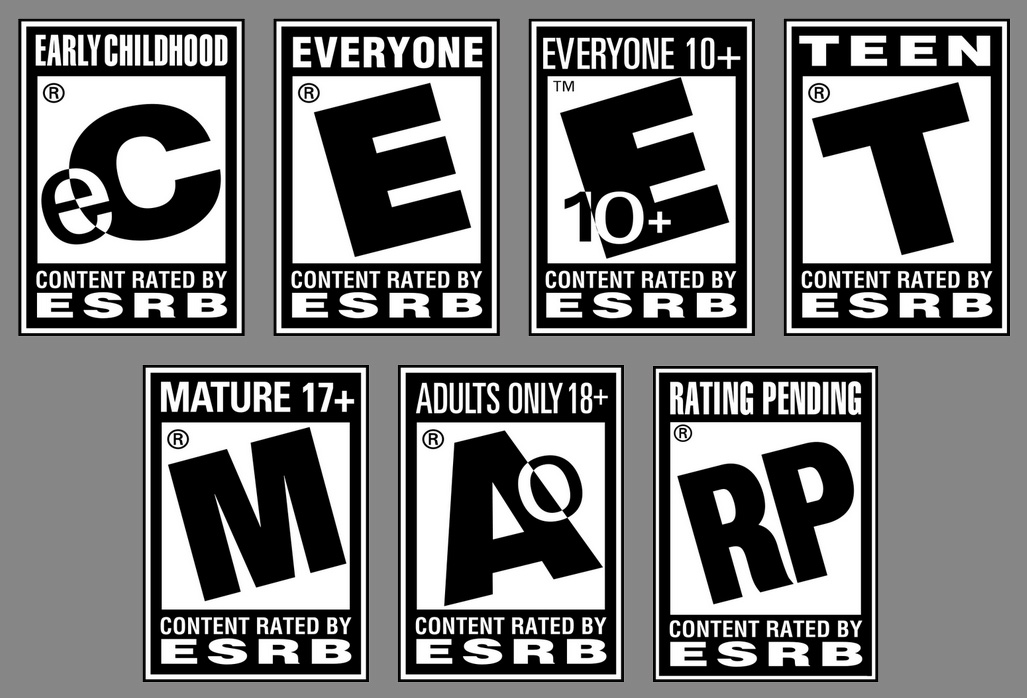
ESRB ratings will include In-game Purchases

After much pressure, the ESRB will add labels along with their video game ratings regarding in-game purchases. ESRB stated in a news release this morning that the labeling will “be applied to games with in-game offers to purchase digital goods or premiums with real world currency, including but not limited to bonus levels, skins, surprise items (such as item packs, loot boxes, mystery awards), music, virtual coins and other forms of in-game currency, subscriptions, season passes and upgrades (e.g., to disable ads).” 28378926_10156024855624000_2501363954117121357_n
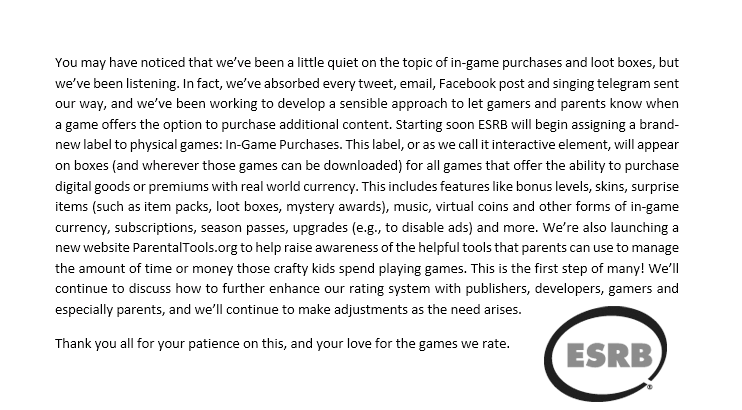
To clarify, this will be separate from the game’s original ESRB age rating. The ESRB is also starting a campaign to educate parents on video game control for children. The president of the ESRB, Patricia Vance, said “If you care about parents, if you care about their concerns, this is an effective response.” Vance stated this is a first step and “are going to continue to look at this issue and determine if there are additional measures or guidelines to put in place. This obviously an issue of concern to the gamer community.” To educate others, they created a separate webpage: parentaltools.org.

Image result for patricia vance esrb

These changes all started due to Electronic Art’s Star Wars Battlefront 2 controversy regarding loot boxes. For a major franchise, EA locked most of the game content through a loot box system which incentives people to buy them with real currency. The state of Hawaii and the United States government pressured the gaming industry, specifically the ESRB, to have greater regulation on games which in-game purchases.

Vance has stated the label will come for all games transactions “If it’s offered from within the game.” They have also received no opposition from publishers…yet. Despite Hawaii representative, Chris Lee, referring the loot box system as gambling, Vance and the ESRB disagree.

“We tried to find research on that,” Vance said, “but we were unable to find any evidence that children were specifically impacted by loot boxes, or that they were leading them toward some tendency to gambling. We truly don’t know of any evidence supporting those claims. We continue to believe loot boxes are a fun way to acquire virtual items; most of them are cosmetic. But they’re always earned and they’re always optional.”

No automatic alt text available.

Vance has noticed that most parents don’t know what a loot box is or how the system even works. Because of that, the ESRB has not created a label for loot box but rather in-game purchases. What most parents are concerned about is their child spending money. Vance has stated “We don’t believe it does [fit the definition of gambling]…you always get something, there’s no way to cash out, and you can complete a game without buying a loot box.” Some publishers have begun to show the drop-rate for certain items for transparency but the ESRB is not enforcing it. Hawaii legislation wants all loot box systems to contain the option similar to gambling. “I think it is important to clarify that these purchases are always optional, are often awarded at no cost to the player, can be acquired using virtual currency that can be earned through gameplay and/or purchased, and are never required to complete the game,” Vance said, drawing the boundaries publishers see between loot boxes and gambling.

The ESRB and Vance are reinforcing their opinion that the ratings are for parents to judge video game purchases and recommend setting up a sub-account for their children’s main game account. Their big focus on Parentaltools.org is to educate parents on in-game purchases.

What do you think of ESRB’s handling of in-game purchases?

Electronic Arts skips E3 again for EA Play

It seems like every big gaming company is trying to host their own events. PlayStation‘s PlayStation Expo and Nintendo’s Directs are central focused events on their IP’s or games coming out for their generation. The events are easier to maintain and there are no competitors to take away from their main showcase. Electronic Arts is one of the largest gaming companies and they are hosting their own event before E3: EA Play.

EA Play will be hosted in Hollywood at the Hollywood Palladium from Saturday, June 9 to Monday, June 11. The event is free for the public and tickets will be released in spring. Last year, they showcased A Way Out, Star Wars Battlefront 2, and Anthem. This year, press has heard they will showcase more information on Anthem, Sims 4, more EA sports and the upcoming Battlefield game. The game is expected to be playable at EA Plays. There may be a new Dragon Age game announced based on an interview in January where Bioware announced they were working on a new title in the franchise.

Similar to last years event, there will be YouTube creators and Twitch personalities at the event. Hopefully its better and less scripted. OR we can watch a prank YouTuber stumble his way through an announcement. That’s always hilarious to watch.

We’ll see if EA improves their image after the Star Wars Battlefront 2 release. Consumers and the government are watching warily at Electronic Arts as it’ll take a while to recover from the loot box controversies.

Sources:

Digital Trends

EA Plays

Screen Rant

Founders of Sledgehammer Games step down

Glen Schofield and Michael Condrey, co-founders of Call of Duty series developer Sledgehammer Games, are both stepping down. After working on Call of Duty: WW2, they will be stepping down to focus on a new role in Activision that is not yet determined.

Schofield thanks Activision for the opportunities as Sledgehammer Games started under their company. Their main focus was on Activision’s shooter franchise but Schofield and Condrey had worked on excellent previous games such as Dead Space and Legacy of Kain: Soul Reaver. Activision has stated that the two will focus on “executive duties” which is separate work from game development. Aaron Halon, a co-founder of Slegehammer will take over the two’s position as lead developer.

Call of Duty: WW2 received a lower score than Modern Warfare 3 and Infinite Warfare but the work Scofield and Condrey was generally received well. Despite this, WW2 sold twice as much as Infinite Warfare.

Activision has offered me the opportunity to focus my energy on something I’m very passionate about, exploring new game ideas for the company,” Schofield said. “It’s something I just couldn’t pass up.”

COD WW2 season pass

“I’m proud of what we accomplished together, it has been the greatest experience of my professional life. I am looking forward to starting a new chapter of my career with Activision,” Condrey said.

Sources:

PC Gamer

Government pushes the ESRB over Loot Box classification and Addiction

Earlier this week, I reported on Hawaii’s representative introduced two bills to regulate distribution of video games with loot boxes. The bills would require games to have a label identifying that it contains loot boxes and would only allow sales of those games to 21+. Today, U.S. Senator Maggie Hassan (D-NH), question the Federal Tech Commission (FTC) about loot boxes and wrote a letter to the head of the ESRB, Patricia Vance, requesting them to a better inspection on loot boxes and the potential effects on players; mainly children.

Before, the ESRB refused to classify loot boxes as gambling as it would force an adult rating on video games based on a interview from Kotaku.

“ESRB does not consider loot boxes to be gambling,” said an ESRB spokesperson. “While there’s an element of chance in these mechanics, the player is always guaranteed to receive in-game content (even if the player unfortunately receives something they don’t want). We think of it as a similar principle to collectible card games: Sometimes you’ll open a pack and get a brand new holographic card you’ve had your eye on for a while. But other times you’ll end up with a pack of cards you already have.”

Hassan was not satisfied with the response from the ESRB and suggested a re-evaluation as opening loot boxes are “expensive habits and use similar psychological principles suggest loot boxes should be treated with extra scrutiny.” While her proposal isn’t as strict as Hawaii’s proposal, her position as a U.S. senator is more prevalent nation-wide. It could end up leading to her proposing federal legislation about this issue, rather than individual states doing it.

The government and most gamers are actually on the same side in regards to the opinion that loot boxes should be regulated more in games but the effect on the industry could be intense. Micro-transaction make a majority of games profits after initial sales. While the goal of all game sales are to make a profit from initial sales, the reason for the huge growth in the industry and making it a worth $30 billion are from practices such as this.

Forbes

Kotaku – Interview with the head of the ESRB

WCCfTech