Potential Lawsuit against EA for Loot Boxes

If there is any company that digs themselves into horrible PR messes, it has to be Electronic Arts. Following the disaster regarding the loot boxes in Star Wars Battlefront 2, EA promised fans they would cut back on loot boxes for future games at E3 this summer. But apparently, they didn’t state they would remove loot boxes from their current games.

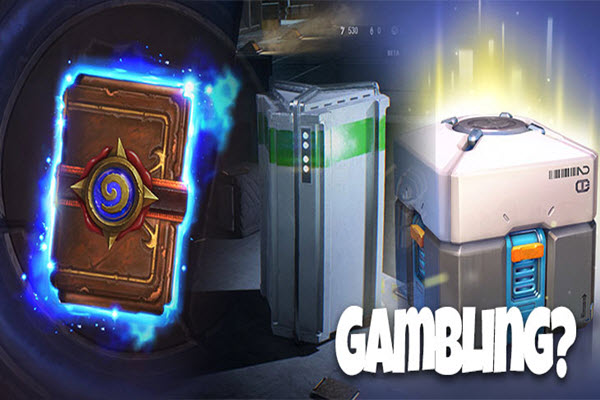
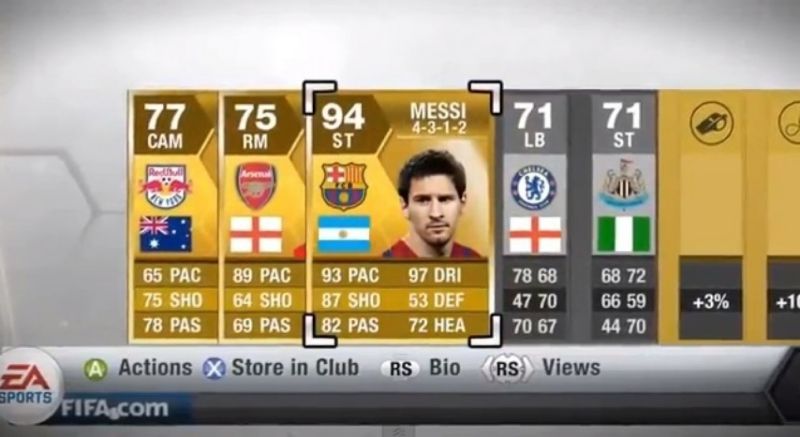
Belgium developed a law that bans “video game gambling for profit” which includes loot boxes. Companies such as Blizzard and 2K have removed their loot boxes from their games earlier this year but EA’s FIFA games still have card packs. Card packs give players the chance to obtain certain players to develop their “Ultimate Team.”  EA’s CFO, Andrew Wilson stated that the loot boxes in FIFA are not a form of gambling.

 “Firstly because players always receive a specified number of items in each pack, and secondly we don’t provide or authorize any way to cash out or sell items or virtual currency for real money..We’re working with all the industry associations globally and with regulators in various jurisdictions and territories, [and] have established that programs like FIFA Ultimate Team are not gambling,” said Wilson (Ars Technica)

Article intro image
Example of FIFA Card Pack

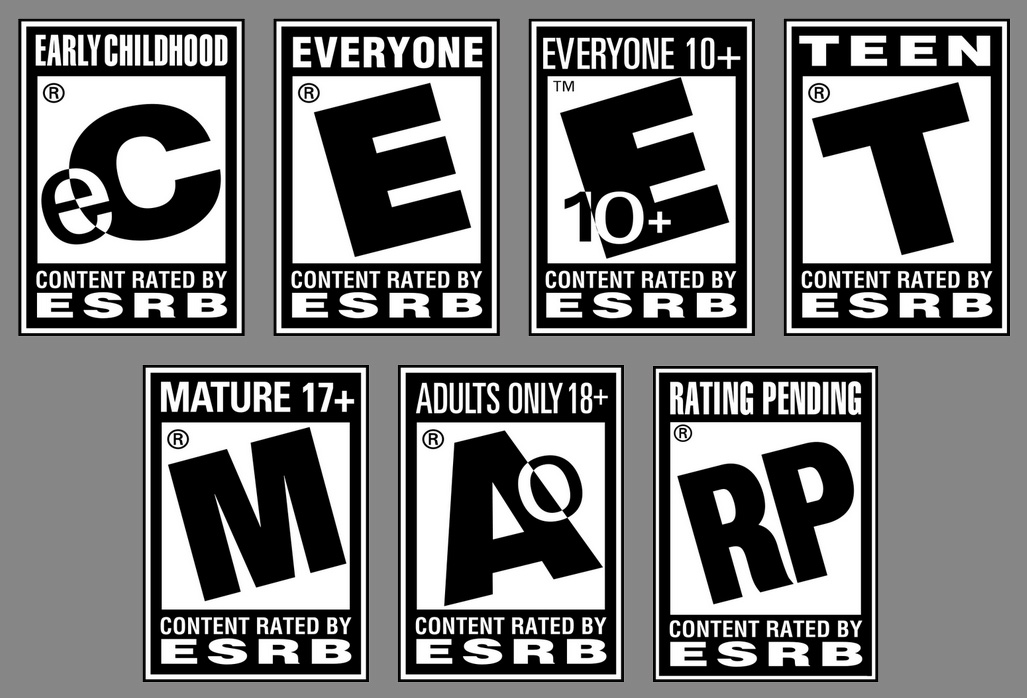
EA recently announced the odds of earning certain cards in July but some fan spent over $10,000 on developing his ultimate FIFA team. EA could potentially be sued by the Belgian government. There are penalties of up to €800,000 and five years in prison, which can be doubled if “minors are involved.” Considering that FIFA is rated E for everyone, the lawsuit could be a major loss in EA’s massive wallet. Whether Belgium will sue remains to be seen.

Sources:

Ars Technica

Rock Paper Shotgun – EA Odds

Eurogamer


New Burnout-Style Game from old Burnout Developers and Creators

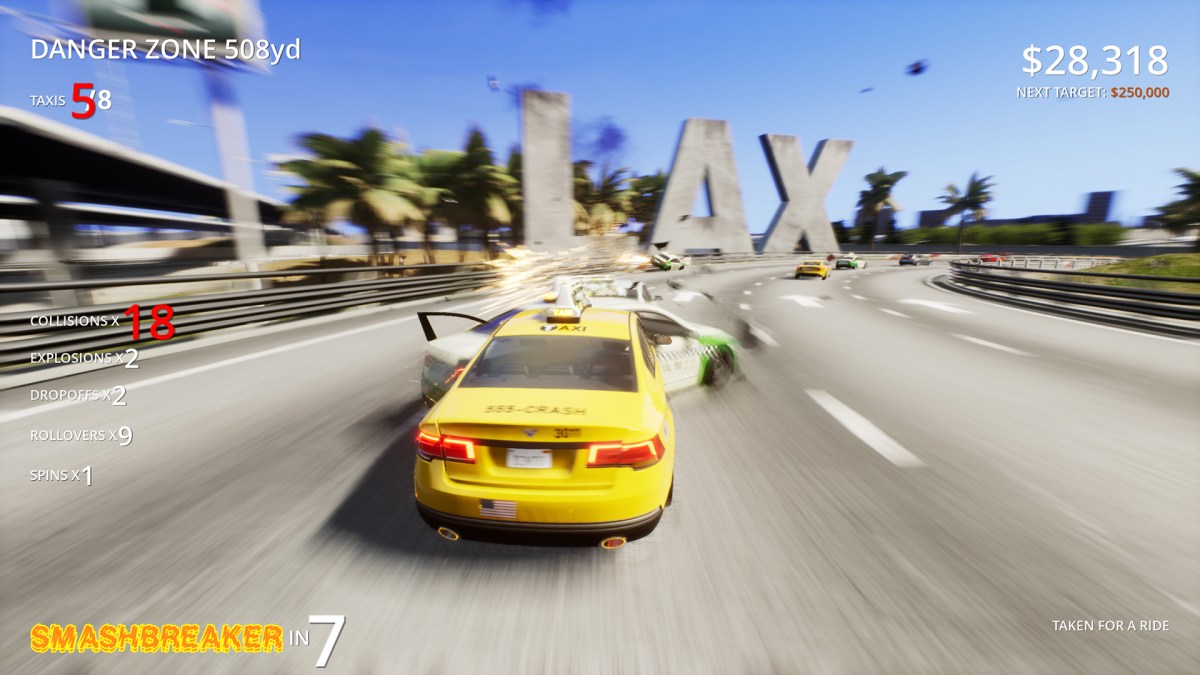
Electronic Arts owns Criterion, the developer studio for Burnout. Unfortunately, the studio hasn’t been working on any new Burnout games since the remake of Burnout Paradise in March. Their last new game in the series was Burnout Crash! which received mix reviews from fans considering it was the follow-up game after Burnout ParadisePrevious founders of Criterion, Alex Ward and Fiona Sperry, spun off their own studio in 2014 called Three Fields Entertainment which has been creating video games similar to Burnout such as Danger Zone. The game is considered a “spiritual successor” to the Burnout series.

https://www.youtube.com/watch?time_continue=47&v=-WC2sdU5vlI

Three Fields Entertainment is releasing Danger Zone 2 on July for PlayStation 4, Xbox One, and PC. There’s a bigger focus on driving and destruction which fans have been asking for. They will also release Dangerous Driving, a closed track competitive racing game featuring boosts, takedowns, destruction and massive car crashes – which sounds a lot more like Burnout. Ward stated, “Dangerous Driving gets me back to making arcade racing, the kind of software I am most passionate about.”

Are you excited to see a new Burnout-style game? Also, those game names are horrible. How is somebody supposes to find these games online?

Sources:

Eurogamer

Eurogamer – Danger Zone Review

Xbox One Sales numbers released by EA

In this current console war, Xbox has greatly fallen behind PlayStation. End of 2017, Xbox Ones have sold 30 million units worldwide compared to the 73.6 million PlayStation 4. In Electronic Arts‘ reports, they discuss the sales for Microsoft and Sony. In a statement by the CFO, Jake Jorgensen stated “Turning to our expectations for fiscal 2019, we expect sales of current-generation consoles from Microsoft and Sony to continue to be strong, with the installed base growing to 130 million consoles by the end of calendar 2018 from 103 million at the end of calendar 2017,” he said. With Sony confirming their sales numbers earlier this year of $79 million, Microsoft makes up for the rest. Microsoft has not officially announced the sales numbers for the Xbox or their gaming division for 2017.

What’s next for Xbox?

Xbox has difficulties staying relevant in the competition. Many of their recent IP releases didn’t sell as many copies as they liked or player base dropped after a few months. Halo 5: Guardians sold 4.8 million units worldwide and Gears of War 4 sold 3.4 million but longtime fans disliked the overall changes. Despite the good sales, the game didn’t leave lasting impressions. Sea of Thieves and Sunset Overdrive are new IP’s that sold relatively well but had a drop off in player numbers after the initial month. Microsoft has been adopting a new strategy by selling some of their exclusive games with cross-play capabilities for Windows. Their backwards compatibility is much better than Nintendo’s and Sony‘s. Their games have better graphics for the Xbox One and if you kept your original copies, you didn’t have to pay any additional cost. Nintendo recently announced there are no plans to bring the Virtual Console store to the Switch and PlayStation 4’s have no backwards compatibility and some ports have performed poorly.  On May 8th, they also announced plans to develop a new studio who will work on new IP’s and are hiring people with “experience shipping high quality titles at AAAA standards.” Whether Microsoft will be able to stay ahead of Nintendo Switch remains to be seen. Microsoft will need to release a huge IP to compete with PlayStation considering their strong year in 2017 with Horizon Zero Dawn and Persona 5 and 2018’s God of War and upcoming Spider-Man game. There is one more month until E3…

Sources:

Variety – EA releases Xbox One’s sales numbers

Variety – Microsoft’s new studio

Halo 5’s sales numbers

Gears of War 4’s sales numbers

Kotaku – No Virtual Console for Switch

ESRB ratings will include In-game Purchases

After much pressure, the ESRB will add labels along with their video game ratings regarding in-game purchases. ESRB stated in a news release this morning that the labeling will “be applied to games with in-game offers to purchase digital goods or premiums with real world currency, including but not limited to bonus levels, skins, surprise items (such as item packs, loot boxes, mystery awards), music, virtual coins and other forms of in-game currency, subscriptions, season passes and upgrades (e.g., to disable ads).” 28378926_10156024855624000_2501363954117121357_n
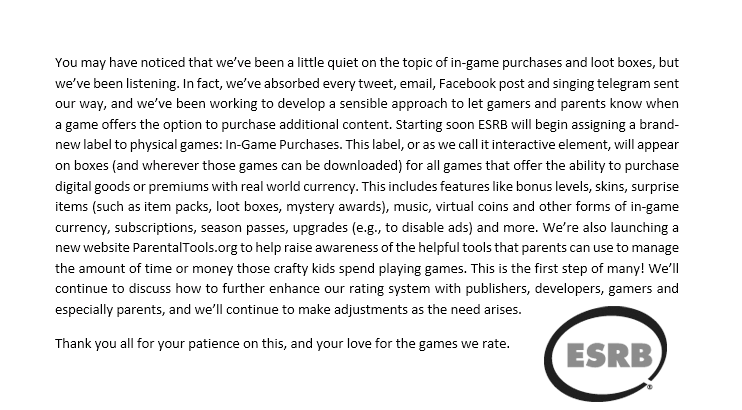
To clarify, this will be separate from the game’s original ESRB age rating. The ESRB is also starting a campaign to educate parents on video game control for children. The president of the ESRB, Patricia Vance, said “If you care about parents, if you care about their concerns, this is an effective response.” Vance stated this is a first step and “are going to continue to look at this issue and determine if there are additional measures or guidelines to put in place. This obviously an issue of concern to the gamer community.” To educate others, they created a separate webpage: parentaltools.org.

Image result for patricia vance esrb

These changes all started due to Electronic Art’s Star Wars Battlefront 2 controversy regarding loot boxes. For a major franchise, EA locked most of the game content through a loot box system which incentives people to buy them with real currency. The state of Hawaii and the United States government pressured the gaming industry, specifically the ESRB, to have greater regulation on games which in-game purchases.

Vance has stated the label will come for all games transactions “If it’s offered from within the game.” They have also received no opposition from publishers…yet. Despite Hawaii representative, Chris Lee, referring the loot box system as gambling, Vance and the ESRB disagree.

“We tried to find research on that,” Vance said, “but we were unable to find any evidence that children were specifically impacted by loot boxes, or that they were leading them toward some tendency to gambling. We truly don’t know of any evidence supporting those claims. We continue to believe loot boxes are a fun way to acquire virtual items; most of them are cosmetic. But they’re always earned and they’re always optional.”

No automatic alt text available.

Vance has noticed that most parents don’t know what a loot box is or how the system even works. Because of that, the ESRB has not created a label for loot box but rather in-game purchases. What most parents are concerned about is their child spending money. Vance has stated “We don’t believe it does [fit the definition of gambling]…you always get something, there’s no way to cash out, and you can complete a game without buying a loot box.” Some publishers have begun to show the drop-rate for certain items for transparency but the ESRB is not enforcing it. Hawaii legislation wants all loot box systems to contain the option similar to gambling. “I think it is important to clarify that these purchases are always optional, are often awarded at no cost to the player, can be acquired using virtual currency that can be earned through gameplay and/or purchased, and are never required to complete the game,” Vance said, drawing the boundaries publishers see between loot boxes and gambling.

The ESRB and Vance are reinforcing their opinion that the ratings are for parents to judge video game purchases and recommend setting up a sub-account for their children’s main game account. Their big focus on Parentaltools.org is to educate parents on in-game purchases.

What do you think of ESRB’s handling of in-game purchases?